

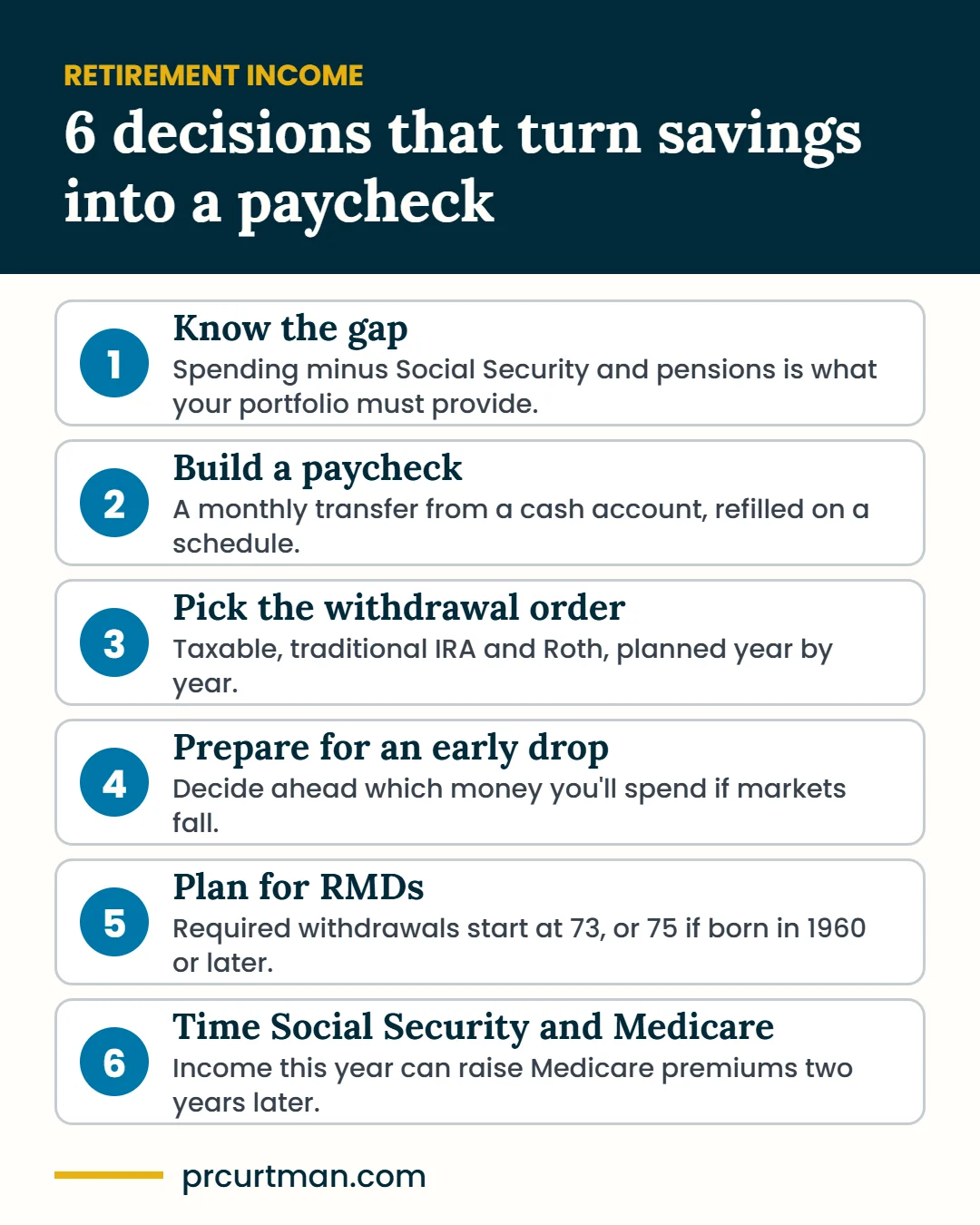
Turning savings into retirement income comes down to a handful of decisions made in the right order: how much your investments need to provide, how the money gets to you each month, which accounts you draw from first, how you’ll handle a market drop early in retirement, and how required distributions, Social Security and Medicare fit together. Getting these right matters more than picking the perfect fund.
Here are the six decisions we walk families through, in plain language.
1. Know the gap your portfolio has to fill
Start with what you spend, not what you have. Add up essential bills and flexible spending like travel and gifts, and include healthcare and an estimate for taxes. Then subtract what you expect from Social Security, pensions and other income. What’s left is the amount your investments need to provide.
| Illustrative annual cash-flow plan | Amount |
|---|---|
| Household budget, including estimated taxes | $180,000 |
| Less Social Security and pension income | ($60,000) |
| Amount the portfolio must provide | $120,000 |
| Monthly portfolio transfer target | $10,000 |
On a $3 million portfolio, $120,000 is a 4% starting withdrawal. That’s arithmetic, not proof the plan will last. Returns, inflation, fees, taxes, longevity and future spending all affect whether it holds up. This example is hypothetical and isn’t a recommended withdrawal rate.
2. Build a paycheck you can count on
Most retirees want income that feels like a paycheck. A scheduled monthly transfer from a cash account inside the portfolio does that. The cash account gets refilled on a written schedule from interest, dividends, maturing bonds and selective sales.
Two cautions. Don’t chase yield alone, because a high payout can come with real risk. And don’t hold too much cash, because it can slow long-term growth and lose purchasing power to inflation. A dependable process isn’t a guaranteed return.
3. Decide which accounts to draw from, and when
A common rule of thumb says to spend taxable accounts first, then traditional IRAs, and Roth accounts last. It’s a reasonable starting point, but it doesn’t fit every household or every year.
- Taxable brokerage accounts: selling can realize gains or losses. Usually only the gain is taxable, not the whole sale.
- Traditional IRAs and 401(k)s: withdrawals are generally taxed as ordinary income, and required distributions may eventually limit your flexibility.
- Roth IRAs: qualified withdrawals are generally free of federal income tax.
Think in years, not just this month. Drawing only from one type of account early can leave a larger problem later. Sometimes taking some IRA income in a lower-income year is worth modeling. Roth conversions belong in the same comparison. See Roth Conversions: When They Make Sense and Investing With Taxes in Mind. Because these choices have tax consequences, we coordinate them with your CPA. We don’t give tax advice.
4. Prepare for a market drop in the first few years
When you’re withdrawing, the order of returns matters. Selling investments after an early decline leaves less money in place for the recovery. Here’s a simple illustration: two portfolios start at $2 million and withdraw $100,000 at the end of each year. Each has one -20% year and one +25% year.
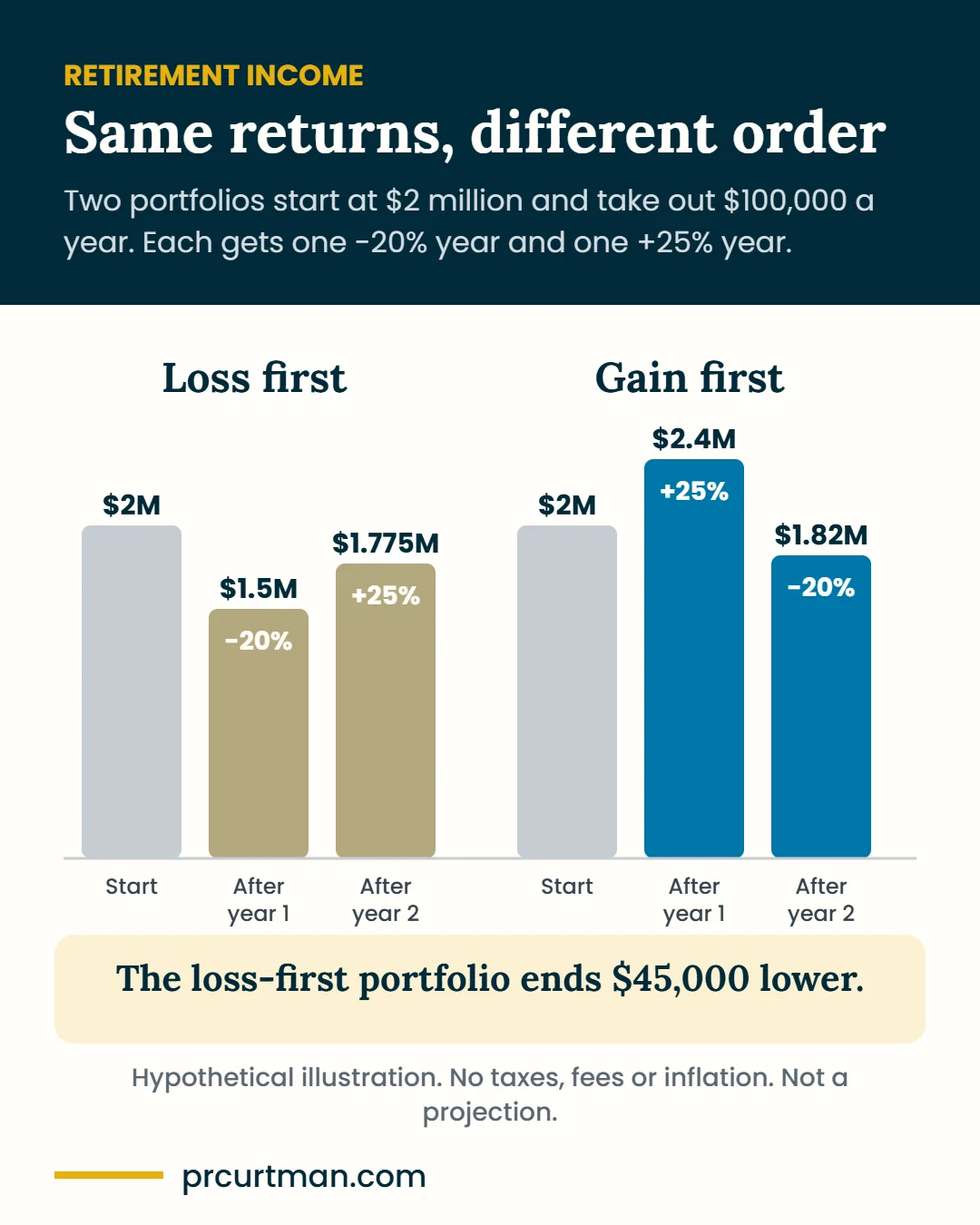
Same two returns, but the loss-first portfolio ends $45,000 lower. This is a simplified mathematical illustration with no taxes, fees or inflation, not a projection. The practical answer is to decide ahead of time how much near-term spending to keep in steadier assets, which expenses you could postpone, and when you’ll refill reserves and rebalance.
5. Build required minimum distributions into the plan
Required minimum distributions (RMDs) are minimum annual withdrawals from certain retirement accounts. Under current rules they generally begin at 73, and at 75 for people born in 1960 or later. Roth IRAs have no lifetime RMDs for the original owner, and inherited accounts follow separate rules.
Watch the first year. You can generally delay your first RMD until April 1 of the following year, but that can put two distributions in one tax year. RMDs are a deadline, not a spending target, so plan where the money goes before it arrives.
6. Time Social Security and watch Medicare surcharges
You can start Social Security as early as 62. Waiting past full retirement age, up to 70, increases your monthly benefit, but it usually means drawing more from your investments while you wait. For couples, the surviving spouse’s income often matters more than the break-even age. More on that in When to Claim Social Security.
Higher income can also raise Medicare Part B and Part D premiums through a surcharge called IRMAA. Medicare generally uses your tax information from two years earlier, so an IRA withdrawal, Roth conversion or large sale this year can show up in your premiums later.
Free guide
The High-Net-Worth Retirement Income Blueprint
Every step above in more detail, with a one-page worksheet to bring to your next planning conversation.
Get the free BlueprintYour next step
- Ready to talk it through? Book a call with Paul. We meet by phone, video, or in person somewhere convenient for you.
- Have a quick question first? Ask it anytime in the chat on this page.
Frequently asked questions
How much can I safely withdraw from my portfolio in retirement?
There’s no single safe number. A starting withdrawal around 4% is a common reference point, but whether it holds up depends on your returns, inflation, fees, taxes, how long you live and how flexible your spending is. The right answer comes from testing your own plan, including a bad market early on.
Which account should I withdraw from first in retirement?
Many people start with taxable accounts, then traditional IRAs, then Roth accounts. That order is a starting point, not a rule. Comparing a few withdrawal mixes year by year, with your CPA, often shows a better path.
When do required minimum distributions start?
Under current law, generally at age 73, or 75 for people born in 1960 or later. Confirm the rule for your birth year and each account.
Does my income affect my Medicare premiums?
It can. Higher-income beneficiaries pay an extra amount on Part B and Part D premiums, based generally on the tax return from two years earlier.
P.R. Curtman Investments is a registered investment adviser. Registration does not imply a certain level of skill or training. This article is general education, not individualized investment, tax or legal advice. Investing involves risk, including loss of principal. No withdrawal rate or strategy guarantees income or that assets will last. Examples are hypothetical. Rules can change, and individual circumstances differ. We do not prepare taxes or give tax advice; consult your tax professional and attorney before acting.
