

A Roth conversion moves money from a traditional IRA to a Roth IRA. You pay income tax on the amount now, and in exchange, qualified withdrawals later are tax-free. It can be a smart move in the right years and an expensive one in the wrong ones.
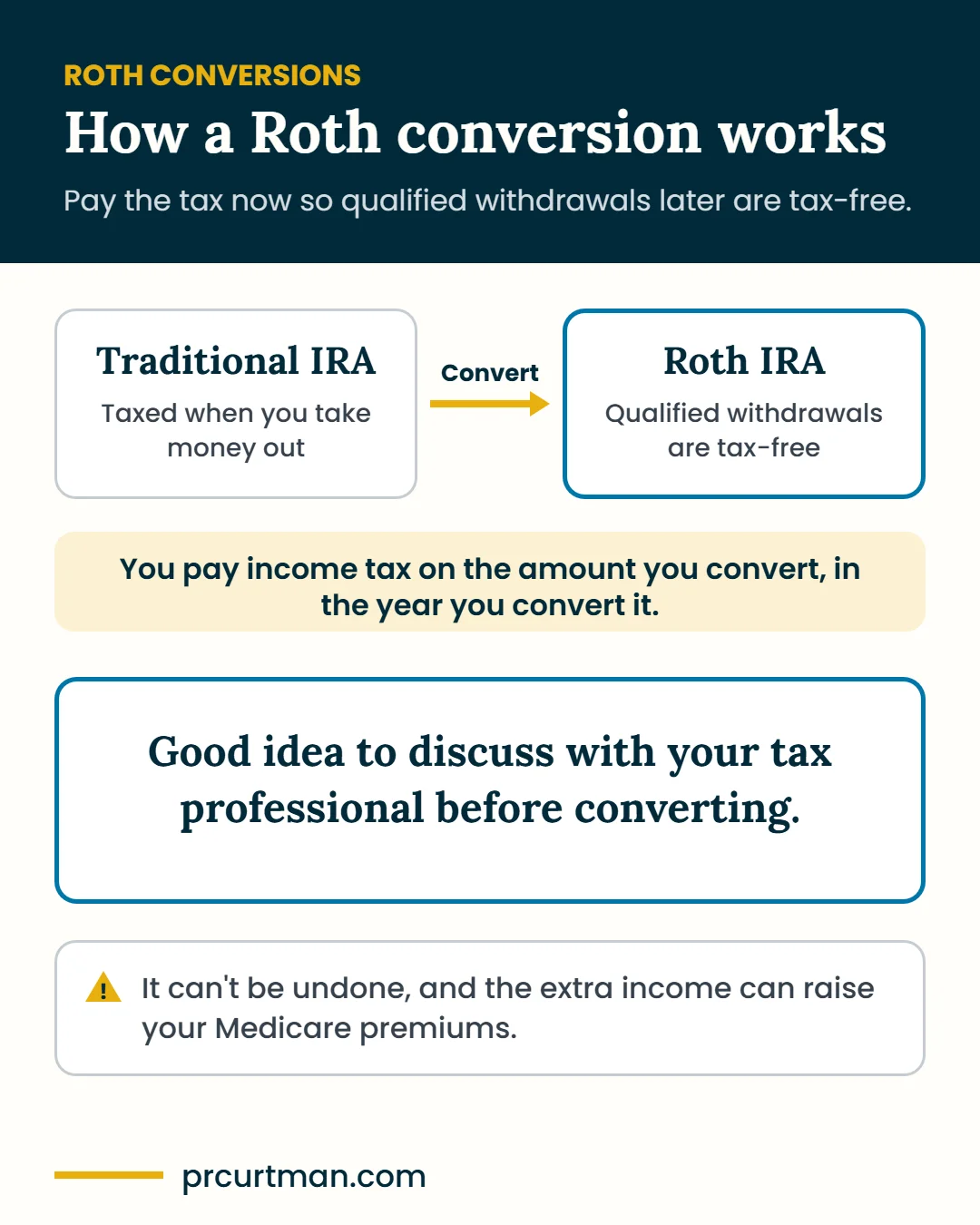
How a Roth conversion works
The amount you convert counts as income in the year you convert it. There’s no income limit on who can convert, and you can convert all of it or a little each year.
Once it’s done, it can’t be undone. That’s the main reason to think it through first.
When a conversion often gets a look
- Lower-income years. The years after you stop working but before Social Security and required withdrawals begin can be a window when your income, and your tax rate, are lower than they’ll be later.
- You expect higher tax rates later. If you think your rate will go up, because of required withdrawals, a pension, or tax law changes, paying now can make sense.
- Money you plan to leave to heirs. Roth IRAs don’t require you to take withdrawals during your lifetime, and heirs generally receive the money tax-free.
- You can pay the tax from other savings. Paying the tax out of the converted money itself shrinks what ends up in the Roth.
The catches
- It can raise other costs. A conversion adds to your income for the year, which can push up the taxes on your Social Security and raise your Medicare premiums a couple of years later.
- The five-year rule. If you’re under 59½, each conversion has its own five-year waiting period before you can take the converted money out without a penalty.
- It may not pay off. If your tax rate later turns out lower than it is today, you may have paid more than you needed to.
Converting a little at a time
Many people convert in pieces over several years instead of all at once. That spreads the tax out and helps keep each year’s income from jumping too high. Done this way, a conversion becomes part of a longer plan, not a one-time decision.
Roth conversions are one part of investing with taxes in mind. See 3 habits that help you keep more.
Where we fit in
We look at Roth conversions as part of your whole picture: your income plan, your portfolio and what you hope to leave behind. You work directly with Paul, by appointment, by phone, video, or in person somewhere convenient for you.
Your next step
- Want the bigger picture? Get the free Retirement Income Blueprint.
- Have a quick question first? Ask it anytime in the chat on this page.
- Ready to talk it through? Book a call with Paul.
This article is for education only and isn’t individual investment, tax or legal advice. Talk with your tax professional about how a conversion affects your taxes.
