


Deciding when to claim Social Security is one of the biggest choices you’ll make. You can start anytime between 62 and 70, and the age you pick sets your monthly check for life. There’s no single right age. The right answer comes from four questions about your health, your spouse, your other income and whether you’re still working.
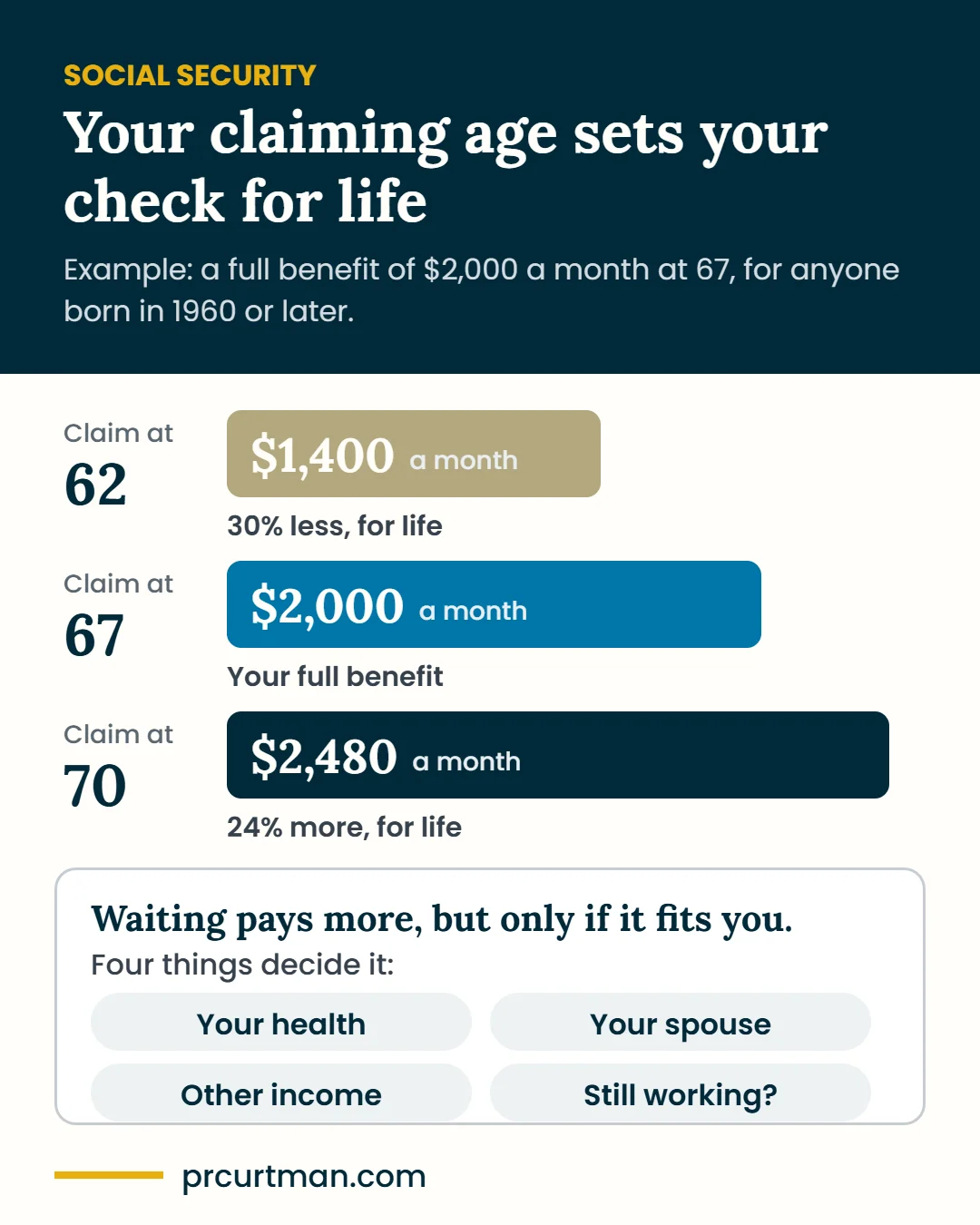
When to claim Social Security: how age changes the check
If you were born in 1960 or later, your full retirement age is 67.
- Claim at 62, and your check is permanently smaller, about 30% less than at 67.
- Claim at 67, and you get your full benefit.
- Wait past 67, and your check grows about 8% for each year you wait, up to age 70.
The gap between the smallest and largest check can be big. That’s why the decision deserves more than a guess.
1. Your health and family history
Waiting pays off only if you live long enough to collect the bigger checks. If you’re in good health and your family tends to live into their 90s, waiting often makes sense. If health is a concern, claiming earlier can be the better call.
2. Your spouse
If you’re married, your decision affects your spouse too.
- A spouse can receive up to half of your full benefit, based on your record.
- When one spouse dies, the survivor keeps the larger of the two checks.
That second point is why many couples have the higher earner wait. It can protect the surviving spouse for decades.
3. Your other income
Waiting to claim means you need money from somewhere else in the meantime: savings, a pension, part-time work. We look at whether your portfolio can bridge those years comfortably, and what that does to the rest of your plan. See How to Turn Savings Into Retirement Income for how the pieces fit together.
4. Are you still working?
If you claim before full retirement age and keep working, Social Security may hold back part of your benefit if you earn above a yearly limit. You get credit for it later, but it surprises a lot of people. Once you reach full retirement age, the limit goes away.
A word on taxes
Depending on your other income, part of your Social Security may be taxable. We plan your withdrawals with that in mind. Your tax professional can tell you how it applies to you.
Where we fit in
We build your claiming decision into your whole income plan, so Social Security, savings and any pension work together. You work directly with Paul, by appointment, by phone, video, or in person somewhere convenient for you. Fee-only, so we do better when you do better.
Your next step
- Want the full picture? Get the free Retirement Income Blueprint. It covers Social Security alongside your other income.
- Have a quick question first? Ask it anytime in the chat on this page.
- Ready to talk it through? Book a call with Paul.
This article is for education only and isn’t individual investment, tax or legal advice. Check your own benefit estimates at ssa.gov.
