

A good year-end investment checklist covers six things: rebalancing, gains and losses, required withdrawals, contribution room, charitable giving and beneficiaries. Most of these have a December 31 deadline, so the best time to review them is November and early December, while there is still time for trades to settle.
You don’t need to do all six every year. Use this year-end investment checklist to spot the ones that apply to you.
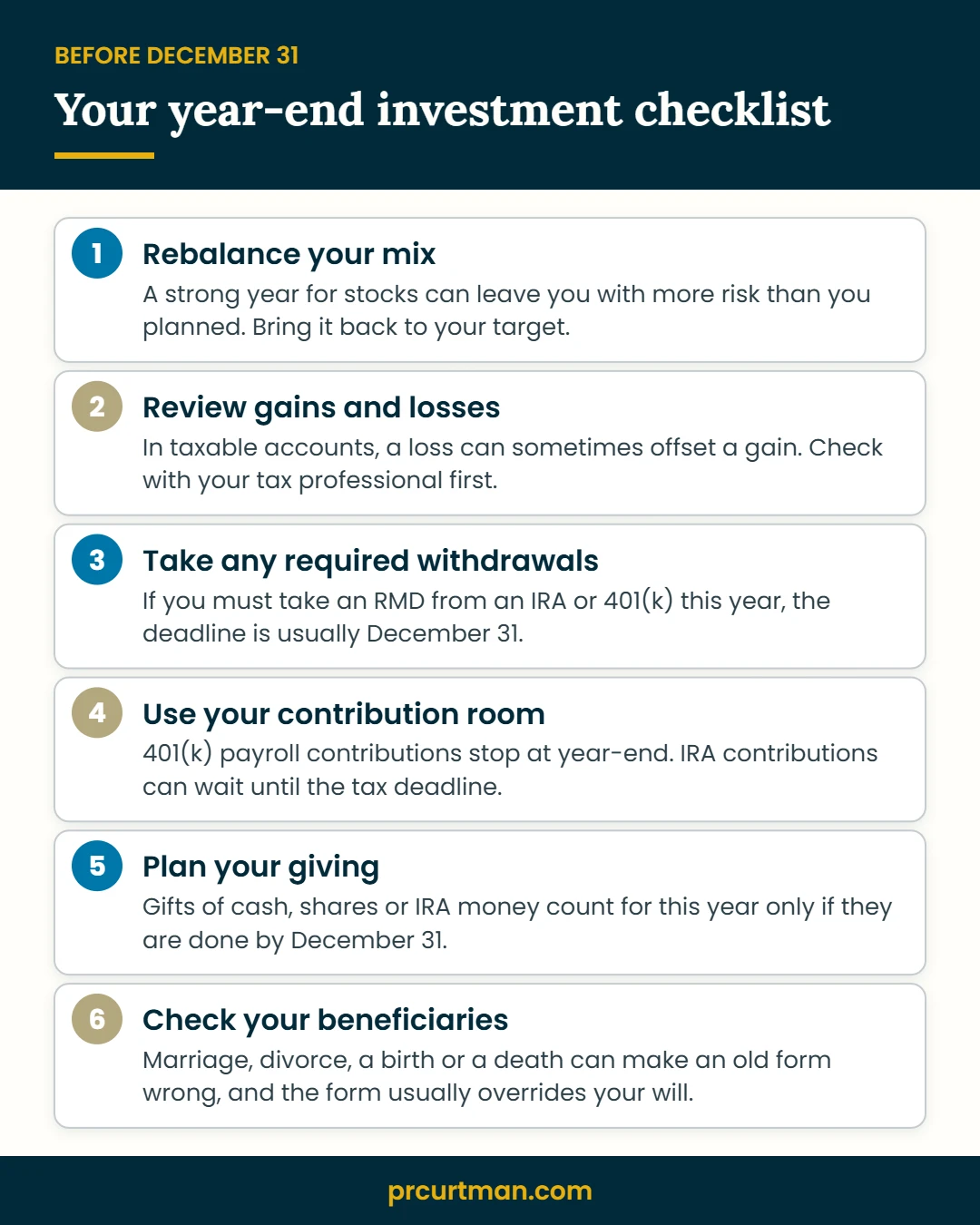
1. Rebalance your mix
Markets move your portfolio away from the mix you chose. After a strong year for stocks, you may be holding more risk than you meant to. Rebalancing means trimming what has grown and adding to what has lagged, so your portfolio matches your plan again.
Where you rebalance matters. Making changes inside an IRA or 401(k) generally doesn’t trigger a tax bill, while selling in a taxable account can.
2. Review gains and losses
In a taxable account, selling an investment at a loss can sometimes offset gains you took earlier in the year. There are rules about buying the same investment back too soon, so this has to be done carefully. Talk with your tax professional before you act. For the bigger picture, see Tax-Efficient Investing: 3 Habits That Help You Keep More.
3. Take any required withdrawals
Once you reach the age for required minimum distributions (RMDs), currently 73 for most people, you generally have to take a set amount from your traditional IRAs and many workplace plans each year. The usual deadline is December 31. Your first RMD can wait until April 1 of the following year, but then you would take two in one year.
Inherited IRAs can have their own withdrawal rules. If you inherited an account, check what applies to it.
4. Use your contribution room
For 2026, you can put up to $24,500 into a 401(k), plus extra catch-up amounts if you are 50 or older (see the IRS announcement). Contributions through your paycheck have to happen by December 31, so check your year-to-date total now while you can still change your election.
IRA contributions work differently. For 2026 the limit is $7,500, plus a catch-up if you are 50 or older, and you have until the tax filing deadline in April to make them.
5. Plan your giving
If you give to charity, the gift generally has to be completed by December 31 to count for this year. A few common ways to give:
- Cash or check, the simplest option.
- Shares you have held a long time, given directly to the charity instead of sold first.
- From your IRA, if you are 70½ or older, through a qualified charitable distribution sent straight from the IRA to the charity.
Each one is treated differently for taxes, so talk with your tax professional about which fits you.
6. Check your beneficiaries
The beneficiary form on an IRA, 401(k) or life insurance policy usually overrides your will. A marriage, divorce, birth or death can leave an old form out of date. Year-end is a good time to pull up each account and confirm the names are right.
Looking ahead to next year
Once the deadlines are handled, map out next year: how much income you will need, how much cash to keep on hand, and whether Roth conversion planning makes sense for you. Our post on Roth conversions explains when it may be worth a look.
If you would like a fresh set of eyes on all of it, a second opinion review looks at what you are paying, how much risk you are taking and how your accounts fit together. You work directly with Paul, by appointment. We meet by phone, video, or in person somewhere convenient for you.
Year-end investment checklist FAQ
When should I do a year-end portfolio review?
November through mid-December works well. That leaves time for trades to settle and for paperwork on withdrawals or gifts to go through before December 31.
What if I miss December 31?
Some items, like IRA contributions, can still be made until the tax deadline. Others, like RMDs and charitable gifts, generally count only for the year they are completed. If you miss an RMD, talk with your tax professional right away.
Do I need to rebalance every year?
Not always. Many people rebalance when their mix drifts past a set range rather than on a calendar date. Year-end is simply a convenient time to check.
Does this year-end investment checklist apply if I am not retired yet?
Yes. Rebalancing, contribution room, giving and beneficiaries apply to anyone with a portfolio. RMDs apply once you reach the required age or if you inherited an account.
Your next step
- Ready to talk it through? Book a call with Paul.
- Have a quick question first? Ask it anytime in the chat on this page.
- Want the bigger picture? Get the free Retirement Income Blueprint. It covers the order to draw from your accounts.
This article is for education only and isn’t individual investment, tax or legal advice. Talk with your tax professional about your situation.
