

Christian investing starts with seven questions for anyone who wants their portfolio to reflect their faith: what the money is for, which convictions should guide it, what you actually own, what “faith-based” means in your strategy, whether the portfolio still makes financial sense, how it supports both retirement and generosity, and whether your legacy reflects your values.
Here’s what each question means and where to look for answers. An unanswered question is a conversation to have, not a failing grade.
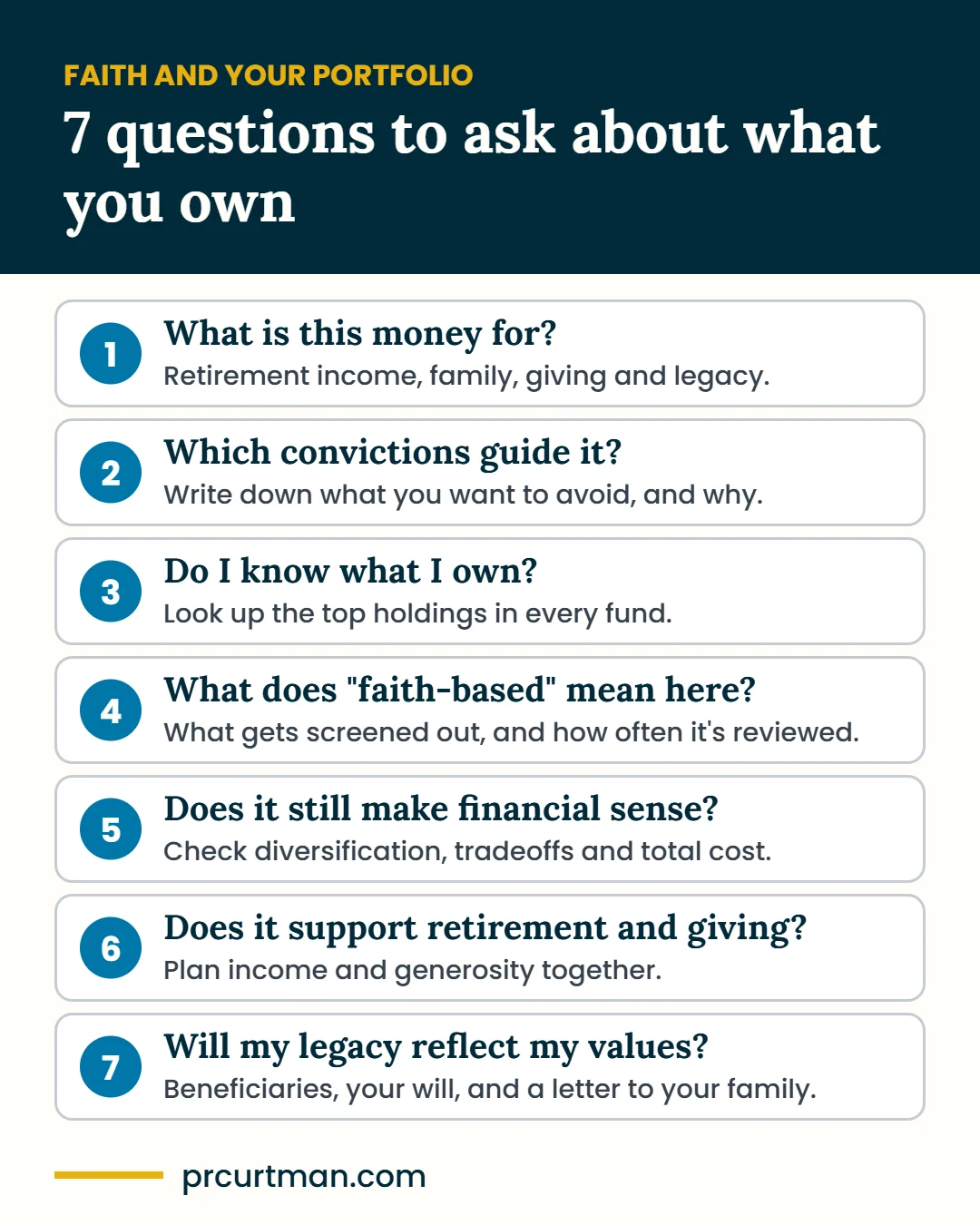
1. What is this money meant to accomplish?
Before choosing investments, name the purposes behind the balance. For most families that’s some mix of retirement income, family needs, generosity and legacy. Purpose shapes everything else, from how much risk makes sense to how much you keep in cash.
2. Which convictions should guide what I own?
Get specific. “I want to invest biblically” is a good start, but it helps to list the activities you want to avoid and why. Some families focus on a few clear issues. Others want a broader set of standards. Writing it down makes it possible to check a portfolio against it.
3. Do I actually know what I own?
This is the question most people skip. A mutual fund or ETF can hold hundreds of companies, and the name on your statement rarely tells you what’s inside. A good first step:
- Pull recent statements for every account, including your 401(k)
- List the funds and look up their top holdings
- Note which accounts have limited choices, like an employer plan
Want help sorting it out? A second opinion on your portfolio is a good place to start.
4. What does “faith-based” mean in this strategy?
The term gets used in different ways. Some approaches screen out certain companies. Some look for companies that meet positive standards. Some use shareholder votes to push companies in a better direction. Many combine all three. Ask what gets screened out and at what level, how often holdings are reviewed, and what happens when a company no longer fits.
5. Does the portfolio still make financial sense?
Conviction doesn’t remove risk. Screening can change how a portfolio performs and what it costs. Check diversification, the tradeoffs involved and the total cost. It’s always your choice how far to go: screened, unscreened or somewhere in between.
6. How will this support both retirement and generosity?
Many families plan income first and treat giving as whatever’s left over. It often works better to plan them together. Tools people ask about include qualified charitable distributions from an IRA, donor-advised funds and gifting appreciated investments. Each has rules and tax effects, so coordinate with your CPA before acting.
7. Will my legacy reflect both care and conviction?
An inheritance is more than money. Check beneficiaries on retirement accounts and insurance, review your will, powers of attorney and any trust, and make sure your family knows where to find important information. Some families also write a short letter explaining the values they hope to pass on.
Free guide
The Christian Investor’s Checklist
All seven questions with checkboxes and a question to ask your advisor for each one. Work through it on your own or with your spouse.
Get the free checklistYour next step
- Ready to talk it through? Book a call with Paul. We meet by phone, video, or in person somewhere convenient for you.
- Have a quick question first? Ask it anytime in the chat on this page.
Frequently asked questions
What is faith-based investing?
Faith-based investing means choosing investments with your religious convictions in mind. It can include avoiding certain companies, favoring others that meet positive standards and using shareholder influence. Approaches vary widely, so it’s worth asking exactly how a given strategy works.
Does faith-based investing hurt returns?
It can make a portfolio perform differently, better or worse in a given period, and it can change costs. It doesn’t remove investment risk. The tradeoffs depend on how strict the screens are and how the portfolio is built.
Can I apply faith-based screens to my 401(k)?
Often only partly. Employer plans have a limited menu, so you may have fewer choices there than in an IRA or brokerage account. Knowing what’s in each option is the first step.
Learn more about our approach to faith-based retirement planning.
P.R. Curtman Investments is a registered investment adviser. Registration does not imply a certain level of skill or training. This article is general education, not individualized investment, tax or legal advice. All investing involves risk, including loss of principal. Faith-based or values-based screening may cause a portfolio to perform differently, and to have different costs, than a portfolio without screens. We do not prepare taxes or give tax advice.
